
FeLV Cats Can Live Long, Healthy Lives: What You Need to Know
Feline Leukemia Virus (FeLV) is often misunderstood, but modern veterinary research shows that many FeLV‑positive cats can live long, healthy, and happy lives. FeLV infects only cats and spreads primarily through close contact, yet the virus is fragile and easy to inactivate in the environment.
1/4/20263 min read

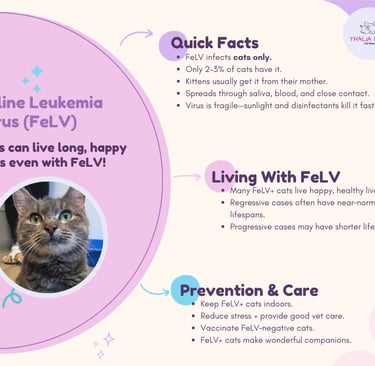
Cats Can Live Long, Healthy Lives: What You Need to Know
Feline Leukemia Virus (FeLV) is often misunderstood, but the truth is far more hopeful than many realize: FeLV‑positive cats can and do live long, happy, healthy lives. Modern research, improved testing, and updated veterinary guidelines show that FeLV is not a death sentence — far from it.
Below is a clear, fact‑based breakdown of what FeLV really means for a cat’s future, supported by credible veterinary sources.
What FeLV Really Is
FeLV infects cats only, not humans or dogs, and affects only 2–3% of the general cat population.
It spreads mainly through saliva, mutual grooming, bite wounds, shared food bowls, and from mother cats to kittens during pregnancy or nursing. [vet.cornell.edu]
The virus is fragile in the environment and survives only a few hours on surfaces. It is easily destroyed by disinfectants, drying, heat, and sunlight. [vet.cornell.edu], [abcdcatsvets.org]
Types of FeLV Infection
Not all FeLV infections are the same — and this is key to understanding prognosis.
Regressive Infection
Virus becomes dormant in the body.
Cats are provirus‑positive but antigen‑negative on routine tests.
They usually stay healthy for years and do not shed the virus.
Stress or illness can rarely reactivate the infection. [abcdcatsvets.org], [wendyblount.com]
Progressive Infection
Virus actively replicates and is shed in saliva and other fluids.
These cats are usually antigen‑positive and more prone to FeLV‑related illness.
Many still remain stable for long periods with proper care. [abcdcatsvets.org]
Why FeLV Cats Can Thrive
Many FeLV‑positive cats, especially those with regressive infection, can live near‑normal life spans, sometimes indistinguishable from FeLV‑negative cats, especially in low‑stress indoor homes. [petscare.com], [abcdcatsvets.org]
Cats with progressive infection may have shorter median survival (around 2.4–2.5 years), yet many exceed these averages with supportive care. [petscare.com]
FeLV cats thrive with:
A low‑stress, predictable environment
High‑quality nutrition
Indoor living
Routine vet care
Prompt treatment of secondary infections [merckvetmanual.com]
Understanding FeLV Testing
Accurate diagnosis matters and not all tests are equal.
qPCR (Recommended)
Detects viral DNA (provirus)
Distinguishes regressive vs. progressive infection
More accurate than antigen testing alone [wendyblount.com]
Antigen tests (ELISA / IFA)
ELISA: Good first‑line test
IFA: Less accurate for defining infection stage [petscare.com]
Veterinary guidelines emphasize that single‑test results may not tell the whole story, and retesting is sometimes needed. [merckvetmanual.com]
Living With FeLV in a Home
Because FeLV requires close, prolonged contact for transmission, casual exposure rarely spreads the virus. [petdvm.com]
Regressively infected cats do not shed the virus, making them safe companions in many settings. [abcdcatsvets.org]
Even progressively infected cats can live happily in:
Single‑cat homes
Homes with other FeLV‑positive cats
Low‑stress, indoor environments [petdvm.com]
Why FeLV Cats Deserve Homes
FeLV‑positive cats are often overlooked, yet they are:
Affectionate
Social
Highly adoptable
Capable of living many good years
Reputable veterinary organizations confirm that FeLV‑positive cats can enjoy a high quality of life, especially with basic supportive care. [abcdcatsvets.org], [merckvetmanual.com]
Final Thoughts
FeLV is not what it used to be. Modern research shows that many FeLV‑positive cats, especially those with regressive infections, can live long, healthy lives, and even cats with progressive infections can remain stable and happy for years.
They deserve compassion.
They deserve homes.
They deserve a chance.
References
American Association of Feline Practitioners. (2020). Feline Retrovirus Testing and Management Guidelines. Summarized in Merck Veterinary Manual. [merckvetmanual.com]
Association of British Cat Doctors (ABCD). (2024). Feline Leukaemia Virus Infection: Fact Sheet. abcdcatsvets.org. [abcdcatsvets.org]
Cornell University College of Veterinary Medicine. (n.d.). Feline Leukemia Virus (FeLV). Cornell Feline Health Center. [vet.cornell.edu]
Hartmann, K. (n.d.). Regressive and Progressive Feline Leukemia Virus Infections: Clinical Relevance and Implications for Prevention and Treatment. LMU Munich. [wendyblount.com]
Merck Veterinary Manual. (2025). Feline Leukemia Virus Disease. Updated February 2022; modified June 2025. [merckvetmanual.com]
PetDVM Editorial Board. (2024). Feline Leukemia: Q\&A. PetDVM.com. [petdvm.com]
PetsCare.com Editorial Team. (n.d.). How Long Do Cats Live With Feline Leukemia? PetsCare News/FAQ. [petscare.com]